You're viewing a lighter version due to slow connection
Inca Trail to Machu Picchu 2026
Walk the same stone-paved paths the Incas walked over 500 years ago. The Inca Trail is not just a trek — it is a journey through history, cloud forest, and breathtaking Andean landscapes that culminates at the Wonder of the World: Machu Picchu.
Showing 3 Inca Trail tours
ModerateFrom $450 USD
Inca Trail to Machu Picchu 1 Day
1 Day
Moderate
Inca Trail 1 day, Machu Picchu, Wiñay Wayna, Inti Punku, tour to Machu Picchu, Inca history, trekking Peru, archaeological tourism.
The Inca Trail — known in Quechua as Qhapaq Ñan or "The Royal Road" — was the backbone of the most powerful empire in pre-Columbian America. At its peak, the Inca road network stretched over 30,000 kilometers, connecting territories from present-day Colombia and Ecuador all the way to northern Argentina and Chile, crossing jungles, deserts, high mountain passes, and coastal plains.
In 2014, UNESCO declared the Qhapaq Ñan a World Heritage Site, recognizing it as one of the greatest engineering achievements of any ancient civilization. The roads were built without wheeled vehicles or draft animals — every stone was placed by hand, shaped with precision tools, and designed to last centuries. And indeed, much of it still stands today.
The section known today as the Classic Inca Trail runs approximately 43 kilometers from the starting point at Km 82 (Piscacucho) through cloud forests, high mountain passes, and a series of remarkable Inca ruins, arriving at the legendary Sun Gate (Inti Punku) — the first panoramic viewpoint overlooking Machu Picchu. It is widely considered one of the most spectacular trekking routes in the world.
Did you know? The Inca Trail is one of the most regulated treks on Earth. Only 500 people per day (including guides, porters, and cooks) are allowed on the trail. Permits sell out months in advance — especially for the peak season between May and September. Book early!
The Chasquis and the Tambos: The Inca Communication System
The roads of the Qhapaq Ñan were not simply built for travel — they were the arteries of an entire civilization's communication and logistics system. At the heart of this system were the Chasquis: elite relay runners trained from childhood to carry messages, food, and small goods across the empire at extraordinary speed.
The Chasquis ran in relays of approximately 2 to 3 kilometers each, stationed at designated points along the road. Using this relay system, a message or a fresh fish from the Pacific coast could travel from Lima to Cusco — a distance of over 1,000 km — in less than three days. It was a feat that Spanish horses could barely match.
Along the trail, at regular intervals, the Incas built Tambos — way stations or rest stops that served as lodging, storage, and supply depots. Tambos were placed roughly every day's walk apart and could accommodate travelers, soldiers, and Chasquis. Several of these structures are still visible today as you hike the trail, offering a direct connection to the logistical genius of the Inca Empire.
🏃 The Chasquis
Young men selected for their physical ability and trained as professional runners. They carried quipus (knotted cords used as records) and small parcels across the empire. Their relay system made the Inca the best-informed rulers of their time.
🏠 The Tambos
Rest stops built every 20–30 km along the Qhapaq Ñan. They functioned as inns, warehouses, and administrative checkpoints. The Tambo at Llactapata, visible on Day 1 of the Classic Inca Trail, is one of the best-preserved examples.
🪨 The Stone Paths
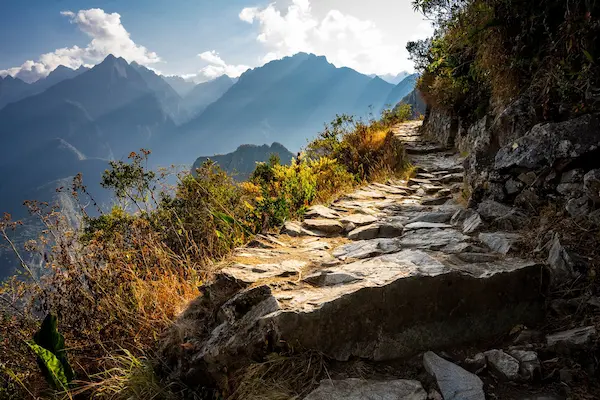
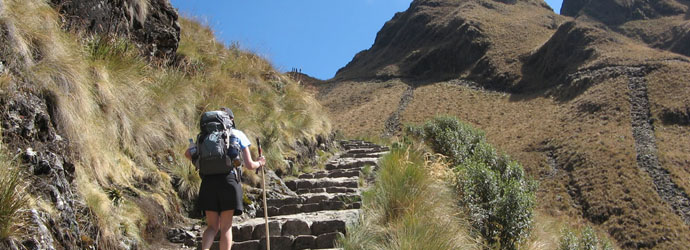
The trail is paved with carefully cut and fitted stones — no mortar was used. The Incas also built escalinatas (stone staircases) carved directly into the mountainside to handle steep sections. After 500 years, they remain largely intact.
🌄 Altitude & Terrain
The Classic Trail reaches its highest point at Warmiwañusca (Dead Woman's Pass) at 4,215 meters above sea level. From there it descends through cloud forest, dropping to Machu Picchu at 2,430 m. The altitude change is significant — acclimatizing in Cusco (3,400 m) for 2–3 days before starting is strongly recommended.
The Classic 4-Day Route: Sites Along the Way
The Classic Inca Trail (4 days / 3 nights) starts at Km 82 (Piscacucho, 2,600 m) and follows an ancient Inca road through cloud forests, alpine grasslands, and two significant mountain passes before arriving at Machu Picchu. Along the way, trekkers pass through some of the most impressive Inca archaeological sites outside of Machu Picchu itself.
Day 1 — Km 82 → Llactapata → Wayllabamba (2,600 m – 3,000 m)
Llactapata ("High Town") is the first major ruin encountered on the trail — a large agricultural complex with terraces and residential structures that once served as a Tambo for travelers heading to Machu Picchu. The day ends with a gradual ascent through subtropical forest to the campsite at Wayllabamba.
Day 2 — Warmiwañusca Pass (4,215 m) → Runkuracay → Sayacmarca
The hardest day. The trail climbs steeply to Warmiwañusca ("Dead Woman's Pass"), the highest point on the trail at 4,215 m. After descending, trekkers pass Runkuracay — a semicircular ruin believed to have been a watchtower and Tambo — before reaching Sayacmarca ("Inaccessible Town"), a dramatic citadel perched on a narrow ridge with spectacular views.
Day 3 — Phuyupatamarca → Wiñay Wayna (3,600 m)
Phuyupatamarca ("Town in the Clouds") sits at 3,600 m and offers stunning panoramic views over the Urubamba Valley below. From there, the trail descends sharply through cloud forest to Wiñay Wayna ("Forever Young") — arguably the most beautiful ruin on the trail, featuring two tiers of terraces, ceremonial fountains, and a residential sector clinging to a near-vertical slope.
Day 4 — Inti Punku → Machu Picchu (2,430 m)
An early start (4:00 AM) to reach Inti Punku (the Sun Gate) at sunrise — the moment most trekkers call the highlight of their lives. The Sun Gate was the main entrance to Machu Picchu for those arriving via the Inca Trail. As the morning mist clears, the citadel appears below in all its glory. The trail then descends into Machu Picchu itself, where a guided tour completes the experience.
The Short Inca Trail (2 days / 1 night)
For those with limited time or who want a lighter version of the experience, the Short Inca Trail starts at Km 104 and covers approximately 13 km. It passes through Chachabamba (a ceremonial complex along the Urubamba River) and climbs to Wiñay Wayna, joining the classic route for the final descent through the Sun Gate into Machu Picchu. It is completed in one afternoon and one morning, with camping at Wiñay Wayna. A demanding but deeply rewarding option.
Best Time to Visit & Closed Season
The Inca Trail has a clearly defined wet and dry season. Choosing the right time to go can make a significant difference in your experience.
May – June
⭐ Best season — clear skies, lush vegetation after rains, moderate temperatures. June is the most popular month.
July – August
⭐ Peak season — driest months, excellent visibility. Book permits 5–6 months in advance.
September – October
✅ Shoulder season — fewer crowds, occasional showers, still very enjoyable. Great alternative to peak.
April
✅ Shoulder season — trail reopens after February closure. Vegetation very green. Some rain possible.
Nov – Jan
🌧️ Rainy season — trail open but wet. Paths can be slippery. Fewer trekkers, lower permit demand.
February
🚫 CLOSED — The entire Inca Trail closes every February for maintenance and to allow the ecosystem to recover.
February closure: Every year, the Peruvian Ministry of Culture closes the Inca Trail during the entire month of February. This is non-negotiable and applies to all trekking groups regardless of permit status. If your travel dates fall in February, consider alternative routes such as the Salkantay Trek or arriving by train from Ollantaytambo — both remain open year-round.
What to Pack for the Inca Trail
👟 Footwear & Clothing
Waterproof hiking boots with ankle support (broken in before the trek). Moisture-wicking base layers, insulating mid-layer, and a waterproof outer shell. Temperatures range from 0°C at night on high passes to 20°C in the cloud forest. Dress in layers.
🎒 Gear Essentials
Trekking poles (highly recommended for descents), a comfortable daypack (6–8 kg max on the trail), and a sleeping bag rated to -5°C or lower. Porters carry your main duffel bag (up to 7 kg of personal gear). A headlamp with spare batteries is essential for the early Day 4 start.
🧴 Health & Protection
High-SPF sunscreen and UV-protection sunglasses (UV radiation is intense at altitude). Insect repellent for the lower cloud forest sections. Personal medications, altitude sickness tablets (consult your doctor), and a basic first aid kit. Drink at least 2 litres of water per day.
📄 Documents & Permits
Your original passport (no photocopies accepted) is required to enter the Inca Trail — this is checked at the Km 82 checkpoint. Your permit is non-transferable and linked to your passport number. Keep it accessible throughout the trek.
🍫 Food & Snacks
Your tour includes all meals (breakfast, lunch, dinner, and snacks). However, bringing personal energy snacks — chocolate, nuts, dried fruit, energy bars — for between meals is strongly recommended, especially on Day 2 approaching the high pass.
💧 Water & Hydration
Water refills are available at camps. Bring a water bottle of at least 1.5L and either water purification tablets or a filter — stream water along the trail is not safe to drink untreated. Staying well-hydrated is one of the best defenses against altitude sickness.
Other Ways to Reach Machu Picchu by Trek
If Inca Trail permits are sold out, the February closure applies to your dates, or you simply want a different experience, several excellent alternative treks also lead to Machu Picchu — each with its own unique landscapes and highlights.
Trek
Duration
Max. Altitude
Difficulty
Highlights
🏔️ Salkantay Trek
5 days / 4 nights
4,600 m (Salkantay Pass)
Moderate – Hard
Dramatic pass beneath Mt. Salkantay (6,271 m), cloud forest, hot springs at Santa Teresa, arrives at Aguas Calientes by train. Open year-round — the most popular alternative to the Inca Trail.
🌿 Lares Trek
4 – 5 days / 3–4 nights
4,400 m
Moderate
Routes through traditional Andean communities, alpaca herds, volcanic hot springs, and woven textile markets. Ends at Ollantaytambo, then train to Aguas Calientes. A culturally immersive alternative focused on living indigenous heritage.
🚂 Classic from Ollantaytambo
1 day (train + bus)
2,430 m (Machu Picchu)
Easy
The most accessible option. Train from Ollantaytambo (or Poroy/Cusco) to Aguas Calientes, then bus to Machu Picchu. Ideal for those with limited time, physical limitations, or traveling with children. Panoramic Vistadome trains offer stunning valley views.
Whichever route you choose, arriving at Machu Picchu never loses its impact. Our team at Viajes Machupicchu Travel can help you plan the perfect itinerary based on your fitness level, available dates, and budget. Contact us and we'll take care of the rest.
Certifications
ISO 9001:2015
Commitment to quality. We are certified with ISO 9001, ensuring excellence in our
services.
ISO 14001:2015
We prioritize environmental sustainability by reducing our impact on the
planet.
Official Operator
Official travel agency and tour operator. Unique and high-quality experiences.
Traveler’s Choice 2026
Recognition of our dedication and excellence in travel experiences.
Recommended by
Information Before Traveling to Machu Picchu
Trips to Machu Picchu, Cusco Tour Packages include hotels, guides, transportation, trains, entrance fees, museums, and transfers.



 Moderate
From $450 USD
Moderate
From $450 USD