
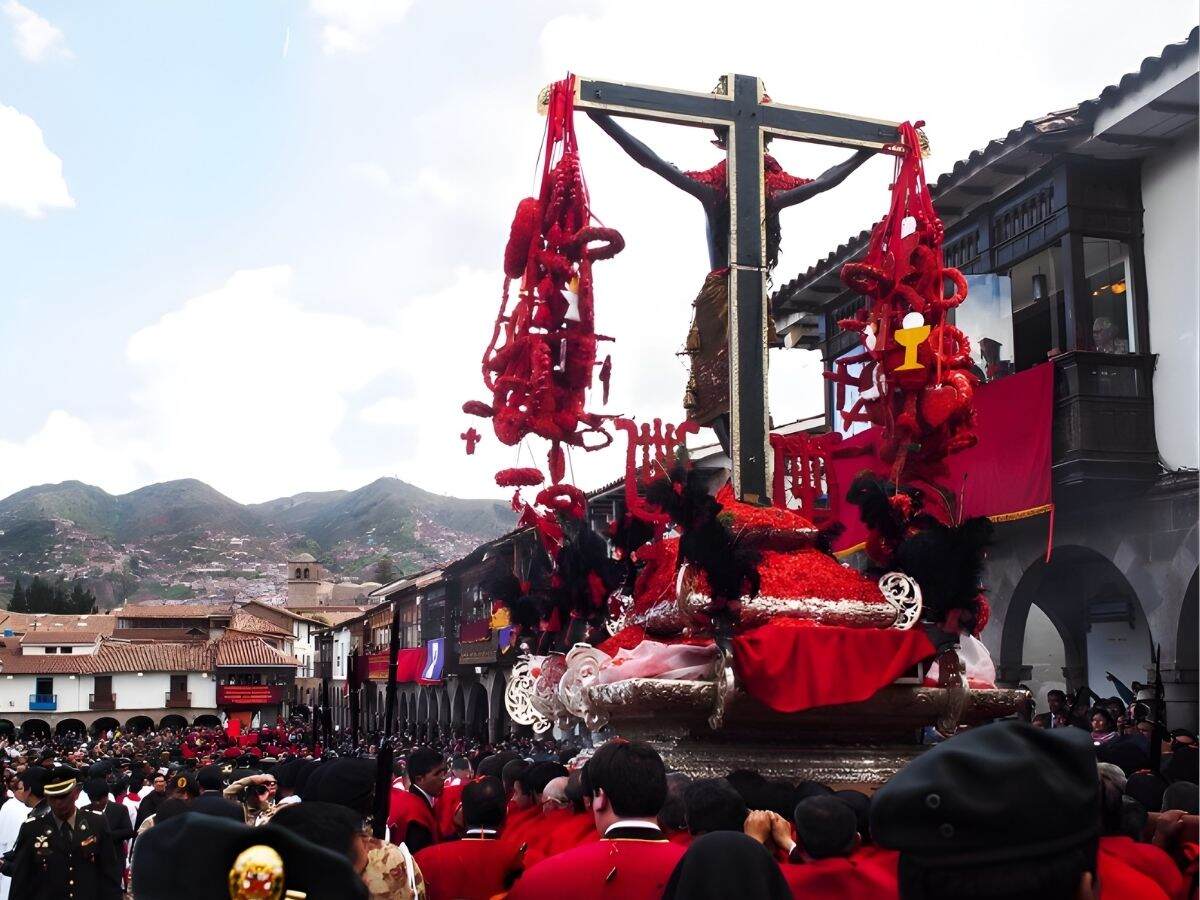
One of the most anticipated and iconic celebrations in the world are the events of Holy Week. Every year, countries with Christian traditions experience this week of reflection, faith, and devotion in a unique way, expressing it through customs and traditions that vary according to their culture and region.
One of those countries is Peru, and in particular, the city of Cusco, where thousands of visitors from all over the world come each year to experience this very special week in a truly unique way.
What is Holy Week?
Holy Week is one of the oldest and most profound celebrations in the Christian world. Its roots go back to the early centuries of Christianity, when the first believers in Jerusalem began walking the same paths that Jesus traveled before his crucifixion. Over time, this practice took shape through biblical readings, fasting, and solemn processions, spreading throughout the world and adapting to the cultures of each region.
Christian beginning of Holy WeekThe Arrival of Holy Week in South America
With the arrival of the Spanish on the American continent in the 16th century came Catholic evangelization. The missionaries and priests who accompanied the conquest introduced European religious celebrations to these territories, but what happened was not simply a replacement of beliefs. it was a fusion between indigenous Peruvian customs and religious ceremonies, integrating into new rites within the Andean worldview.
Cusco, the ancient capital of the Inca Empire and heart of the Tahuantinsuyo, holds within its Cathedral one of the most beloved and venerated images of this celebration: the Lord of the Earthquakes.
Its origin dates back to the colonial era, but it was a dramatic event that forever sealed the bond between this image and the people of Cusco. On May 31, 1650, a devastating earthquake struck the city, and according to tradition, when the image was brought out in procession, the tremor ceased. From that moment on, the Lord of the Earthquakes became far more than a religious figure, he became the Sworn Patron of Cusco, the protector to whom the people turn in times of uncertainty and pain.
Start of Holy Week in AmericaWith him, the events of Holy Week in Cusco took on a unique dimension, ceasing to be simply a celebration imported from Europe and becoming an expression of its own, where Andean faith and Christian tradition merged into a single voice.
Events of Holy Week in Cusco 2026
Palm Sunday | March 29
The week opens with one of the most beautiful and simple moments among all the events of Holy Week. Devotees attend different churches throughout the city of Cusco carrying crosses woven from palm leaves, which are blessed during Mass. These crosses are then placed in each home as a symbol of protection. At the Cathedral on the Plaza de Armas, the blessing Mass begins as early as 6 in the morning, bringing together hundreds of Cusco families who begin their Holy Week in this way.
palm sunday marks the beginning of events of holy week in CuscoHoly Monday | March 30 | Procession of the Lord of the Earthquakes
This is, without a doubt, one of the most anticipated events of Holy Week in Cusco. On Holy Monday, the Taytacha of the Earthquakes sets out in procession a name in Quechua meaning “Little Father of the Earthquakes,” the affectionate title the people of Cusco give to their most beloved image, the Lord of the Earthquakes, Sworn Patron of the city. He is welcomed with prayers, songs, and the deep emotion of thousands of devotees, as the image solemnly makes its way through the main streets of the historic center in an atmosphere of faith that is hard to find anywhere else in the world.
During the procession, balconies are adorned with flowers and cloths, and people offer prayers, songs, and above all, petals of ñucchu a deep red Andean flower that symbolizes the blood of Christ. The ñucchu flower is no minor detail: it is precisely one of the elements that gives this event its unique character in the world, as it is considered a sacred and healing plant.
sacred image of the Lord of the Earthquakes of CuscoAs night falls, around 7 p.m., the Plaza de Armas fills with devotees from different parts of Peru, thousands of people gather to receive the blessing of the Taytacha of the Earthquakes, one of the most iconic moments of Holy Week in Cusco.
Holy Thursday | April 2 | National Holiday
One of the most family-oriented and meaningful events of Holy Week in Cusco is the Visit to the Seven Churches, a nighttime pilgrimage through seven key temples in the city. This practice is a symbol of devotion combined with a journey through Cusco’s colonial heritage, offering a unique opportunity to discover the city in depth at an unusual hour.
Church visits on Holy ThursdayAt the table, this day holds a very particular gastronomic tradition: the preparation of the twelve dishes, a special meal that symbolizes the twelve apostles. These dishes are generally prepared without red meat, using mainly fish, seafood, grains, and other traditional Andean ingredients. More than a meal, it is a moment of family gathering, keeping alive a custom that has been passed down from generation to generation.
Good Friday | April 3 National Holiday
Good Friday is the most solemn event of the entire week, dedicated to commemorating the crucifixion and death of Jesus Christ. In the city of Cusco, the Stations of the Cross are reenacted, beginning at Plaza San Francisco and ending at the Cruz del Papa, located at Sacsayhuamán, an event organized by the Convent of San Francisco.
empanadas on Good FridayBut Cusco has something additional that makes this event of Holy Week truly special: at the same time, in Plaza San Francisco, the Hampi Rantikuy takes place a fair where different types of medicinal plants are sold. Tradition holds that all plants gathered during Holy Week are blessed. This sacred herb market is yet another perfect manifestation of the Andean-Catholic syncretism that defines the spiritual identity of Cusco.
Throughout this day, fasting or abstaining from food until a certain hour is very common. Some also prepare their twelve dishes on this date after breaking their fast.
Easter Sunday | April 5
The last and most joyful of all the events of Holy Week closes the week with jubilation. The faithful attend Mass from 6 in the morning to celebrate the resurrection of Christ. On this day, the image of the Risen Jesus also sets out in procession, accompanied by worshippers who express their joy in the streets.
After the processions and liturgical celebrations, the streets fill with the aroma of traditional dishes such as chicken broth, empanadas, tamales, white corn sweets, and homemade cakes. In this way, the imperial city bids farewell to the events of Holy Week with a combination of religious fervor and popular celebration.
Syncretism: The Defining Mark of the Events of Holy Week in Cusco
What makes the events of Holy Week in Cusco unique compared to any other celebration in the world is precisely that inseparable blend of Andean and Catholic elements. Colonial churches such as the Cusco Cathedral and the Church of the Society of Jesus become the setting for Masses and liturgical acts, many of which incorporate traditional songs and prayers in Quechua.
The ñucchu flowers thrown in the path of the Lord of the Earthquakes, the palm crosses on the doors of homes, the medicinal plants blessed at the Hampi Rantikuy, the twelve dishes prepared with products of the Andean land everything speaks of a people who found a way to keep their deepest soul alive within a new faith.
Events of Holy Week in Other Cities of Peru
While Cusco takes center stage during Holy Week, events of equal intensity are experienced in other parts of the country:
Holy Week in Ayacucho
Is recognized as the “Holy Week capital” of Peru. Its celebrations last ten full days and include impressive nighttime processions, carpets of flowers and colored sawdust, and a popular devotion that transforms the entire city.
Holy Week in AyacuchoHoly Week in Tarma
The Junín region, is famous for its spectacular floral carpets that cover the streets of the historic center, considered among the most elaborate and colorful on the entire continent.
Holy Week in Lima
The events of Holy Week with visits to its colonial temples in the historic center, large-scale Masses, and traditional seasonal gastronomy with chupe de viernes (Friday chowder) and criolla sweets as the stars of Lima’s tables.
Places You Can Visit During Holy Week in Cusco
If you find yourself in the city of Cusco during these dates, you can enjoy and take advantage of the opportunity to explore places near the imperial city. Among the tours and destinations you can make the most of:
- City Tour Cusco
- Sacred Valley of Incas
- Rainbow Mountain
- Humantay Lake
- Machu Picchu in 2 Days
- Holy Week in 6 Days
If you need more details or information about the city of Cusco, feel free to reach out the Viajes Machu Picchu team will be happy to answer any questions you may have.