
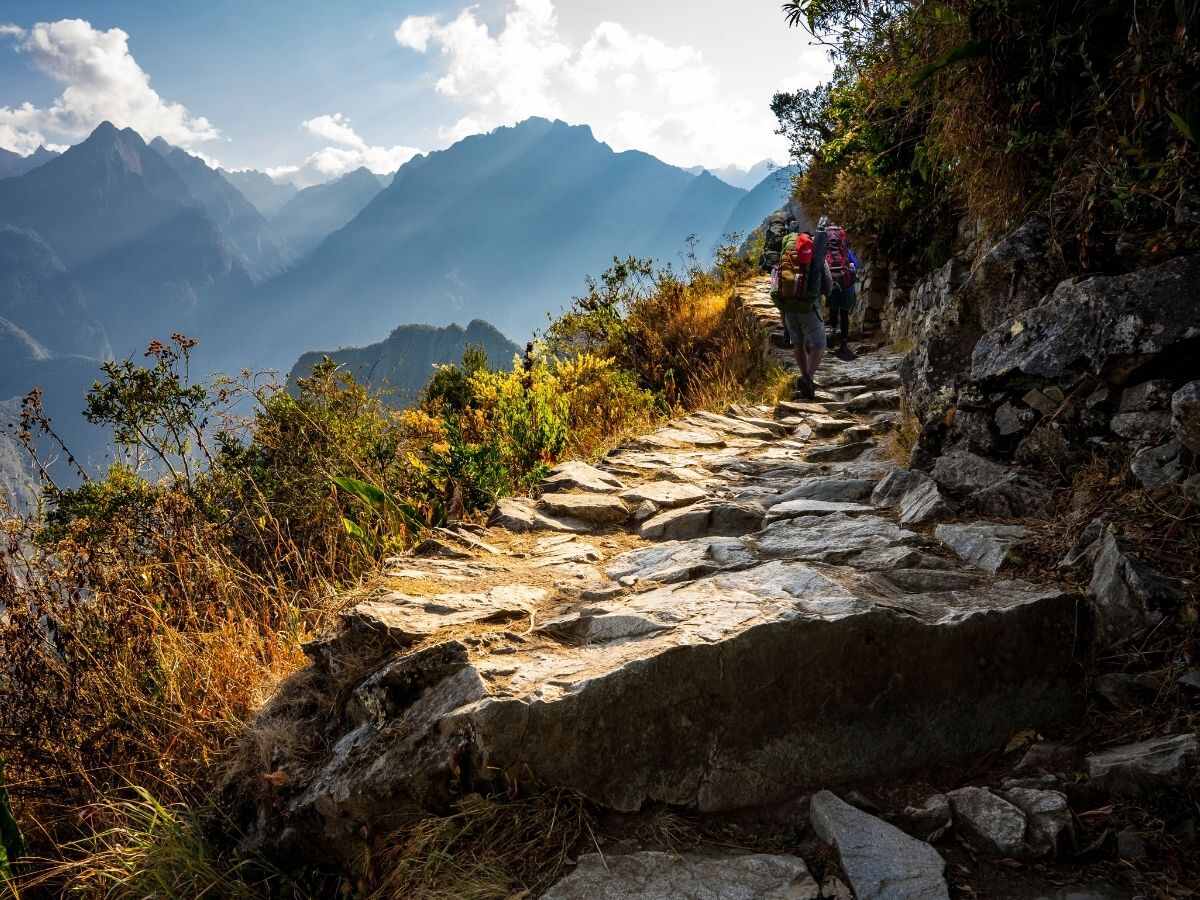
The Inca Trail to Machu Picchu is not just a hike. It is one of the most iconic trekking routes in the world a four-day journey through ancient ruins, cloud forest, and high Andean passes that ends at the most breathtaking entrance to any archaeological site on Earth: the Sun Gate, perched above the Lost City of the Incas.
Each year, thousands of travelers from every corner of the globe make this pilgrimage. And almost all of them say the same thing afterward: it changed them. Not because it was easy, but precisely because it wasn’t. Whether you are an experienced trekker or someone lacing up hiking boots for the first time, this guide covers everything you need to plan your Inca Trail to Machu Picchu experience and arrive at the citadel the way it was always meant to be approached.
What Is the Inca Trail to Machu Picchu?
The Inca Trail is a trekking route that forms part of the Qhapaq Ñan translated from Quechua as “the main road” a monumental network that once stretched more than 30,000 kilometers across six South American countries: Peru, Ecuador, Bolivia, Colombia, Chile, and Argentina. At its height, this system connected the entire Tahuantinsuyo empire, the largest empire in pre-Columbian America.
The most famous section the one people mean when they say “the Inca Trail to Machu Picchu” is the classic 4-day route. It begins at Kilometer 82 of the railway connecting Ollantaytambo to Aguas Calientes and covers approximately 43 kilometers of original Inca-paved paths. Along the way, hikers pass through multiple ecological zones: from high-altitude Andean grasslands above 4,200 meters, down through temperate valleys, and into lush cloud forest thick with orchids and mist.
Messenger’s journey on the Inca TrailWhat makes this route unique is its ending. Unlike any other trek in the world, the Inca Trail to Machu Picchu brings you through Intipunku the Sun Gate the original ceremonial entrance used by the Incas themselves. Arriving here at dawn, with the citadel emerging from morning fog below you, is a moment that stays with a person for life.
In 2014, the Qhapaq Ñan was recognized by UNESCO as a World Heritage Site, reflecting both its historical significance and the ongoing commitment to preserve it for future generations.
A Brief History: Who Built This Trail?
Construction of the trail dates to the 15th century, during the reign of Emperor Pachacute the visionary ruler who transformed the Inca state from a regional power into a continental empire. The road connecting Cusco to Machu Picchu was built under his command, functioning as both a pilgrimage route and a demonstration of imperial reach.
Several sections of the Qhapaq Ñan have pre-Inca origins, built by earlier civilizations such as the Wari and Tiahuanaco cultures. The Incas expanded and integrated these paths into a coherent system, adding tambos (roadside inns), qollqas (storage warehouses), and suspension bridges infrastructure that allowed armies to mobilize, chasquis (relay runners) to carry messages, and llama caravans to transport goods across radically different terrains.
During the Spanish colonial era, much of the network fell into disrepair or was deliberately abandoned. It was not until 1911, when American historian Hiram Bingham reached Machu Picchu with the guidance of local farmer Melchor Arteaga, that the outside world began to rediscover these paths. Decades later, in 1970, Peruvian archaeologist Víctor Angles Vargas carefully mapped the modern route, laying the groundwork for the regulated trekking experience it is today.
Inca Trail to Machu Picchu Routes: Which One Is Right for You?
Classic Inca Trail – 4 Days / 3 Nights
This is the definitive experience. Over four days and roughly 43 kilometers, the trail carries you from Kilometer 82 through cloud forest, high passes, and hidden archaeological wonders ending precisely where the ancient Incas intended: the Sun Gate, at first light on the final morning. Demanding, deeply rewarding, and the most complete way to understand what this journey truly means. If you have the time and fitness, this is the one.
Short Inca Trail – 2 Days / 1 Night
Starting at Kilometer 104, this condensed version covers approximately 12 kilometers and is a good fit for travelers with limited time, families with older children, or those who want the emotional payoff of entering Machu Picchu through the Sun Gate without committing to the full four days. It still passes through Wiñayhuayna, one of the most spectacular ruins on the entire route.
Salkantay Trek – 5 Days
Technically a different route but the most popular alternative for hikers who cannot secure Inca Trail permits. The Salkantay Trek passes beneath the imposing Salkantay peak (6,271 meters) and also ends at Machu Picchu. It is longer and in some sections more demanding, but permits are easier to obtain and the scenery is extraordinary in its own right.
How Long Is the Inca Trail to Machu Picchu?
The classic route covers approximately 43 kilometers over four days. Daily hiking distances range from 7 to 16 kilometers, with walking times of five to eight hours per day depending on the terrain and your pace. The second day is the shortest in distance but the hardest in terms of elevation gain it includes the ascent to Dead Woman’s Pass at 4,215 meters above sea level, the highest point on the trail.
For context, the Short Inca Trail covers about 12 kilometers in two days, making it more accessible for those with less experience or time.
Map of the 4-day Inca Trail tourLandscapes and wildlife you will find on the Inca Trail to Machu Picchu
One of the most underappreciated aspects of hiking to Machu Picchu this way is the ecological variety. In just four days, you walk through more than ten distinct ecological zones, each with its own climate, flora, and character.
The trail runs through a protected area home to over 450 bird species and more than 200 species of orchids. Notable wildlife includes spectacled bears, Andean deer, vizcachas (a rabbit-like relative of the chinchilla native to the Andes), and the Andean cock-of-the-rock Peru’s national bird with its unmistakable scarlet crest.
As you descend toward Machu Picchu on the final days, the landscape shifts dramatically. The sparse, windswept highlands give way to warm, humid cloud forest. Mossy trees close in around the trail. Waterfalls appear through the vegetation. The sounds of the mountains are replaced by birdsong. Many hikers describe this transition as one of the most memorable parts of the entire walk to Machu Picchu.
biodiversity on the Inca Trail to Machu PicchuArchaeological Sites Along the Trail
The Inca Trail to Machu Picchu is the only long-distance trek in the world where significant archaeological ruins appear at multiple points along the route itself not just at the destination. Each site tells a different story about Inca civilization.
Llactapata
An agricultural and ceremonial complex near the start of the trail, with sweeping views of the Veronica massif. Recent research suggests it served as an astronomical observation point aligned with Machu Picchu.
Runkurakay
A circular structure at high altitude that functioned as a tambo, or rest station, for travelers and relay messengers using the road.
Sayacmarca
A hilltop complex accessible only by a narrow stone staircase, featuring agricultural terraces, water channels, and ceremonial plazas with commanding views.
Phuyupatamarca
Its Quechua name means “town above the clouds,” and it earns that name completely. The site features a series of ritual baths fed by a natural spring that still flows today.
Wiñayhuayna
Perhaps the most visually impressive ruin on the trail, with cascading agricultural terraces, ceremonial baths, and a dramatic position above the Urubamba River valley. Most hikers spend their final night camped near here.
How Difficult Is the Inca Trail to Machu Picchu?
The classic route is rated moderate to high difficulty. No technical mountaineering experience is required, but the trail should not be underestimated. The combination of altitude, elevation changes, and uneven stone paving demands genuine physical preparation.
Day 1: A relatively gentle introduction. Mostly flat or gradual uphill along the Urubamba River valley. Good for warming up and finding your rhythm.
Day 2: The hardest day. The ascent to Dead Woman’s Pass (Warmiwañusca, 4,215 m) is relentless and slow at altitude. This is followed by a steep descent to the second campsite. Most hikers spend four to six hours on this section. Completing it is one of the trail’s most satisfying milestones.
Day 3: Long in distance but arguably the most rewarding. You pass through multiple archaeological sites including Runkurakay, Sayacmarca, and Phuyupatamarca, descend into cloud forest, and arrive at camp near Wiñayhuayna.
Day 4: An early start (typically 3:30–4:00 AM) to reach the Sun Gate at dawn. A short but emotional final stretch brings you to your first view of Machu Picchu. The rest of the day is spent exploring the citadel.
The altitude during the Inca Trail to Machu Picchu.
Altitude sickness affects people regardless of age, gender, or fitness level. Cusco sits at 3,400 meters. The highest point on the trail reaches 4,215 meters. If you fly into Cusco and start trekking the next day, you are taking a real risk.
view of the Inca Trail to Machu PicchuWhat to do:
- Spend at least two nights in Cusco or the Sacred Valley before your trek begins
- Hydrate consistently significantly more than you would at sea level
- Avoid alcohol in the 48 hours before and during the trek
- Eat lighter meals in the first days at altitude
- Walk slowly the local concept of “despacio pero seguro” (slow but steady) is genuinely useful advice
Symptoms of altitude sickness include headache, nausea, dizziness, and fatigue. If symptoms are mild, rest and hydrate. If they become severe persistent vomiting, confusion, or loss of coordination descend immediately. This is especially important to keep in mind on the Inca Trail to Machu Picchu, where elevations can exceed 4,200 meters. Your guide will carry supplemental oxygen and is trained to handle high-altitude emergencies.
Permits and Booking: What You Need to Know
Access to the Inca Trail to Machu Picchu is strictly controlled by Peru’s Ministry of Culture. A maximum of 500 people may enter per day 200 hikers and 300 support staff (guides, porters, cooks). This cap protects the trail’s ecology and structural integrity.
Critical rules:
- Inca Trail to Machu Picchu permits are non-transferable and linked to your passport number. No name changes are allowed once issued.
- Independent trekking is not permitted. Every hiker must enter with a licensed, registered operator.
- Porters are legally limited to carrying 20 kg total (including their personal gear). Reputable operators comply with this fully.
- All waste must be packed out. The trail operates under strict Leave No Trace policies.
When choosing an operator, look beyond the price. A company that pays porters fairly, provides proper equipment, and employs certified bilingual guides offers a fundamentally different experience than one cutting corners. Ask directly about porter conditions before booking.
Best Time to Hike the Inca Trail to Machu Picchu
Dry Season (April to October) is the most popular window. Trails are drier, skies are clearer, and conditions are most predictable. Peak months May, June, and July offer consistently clear days and cool temperatures. Daytime highs sit around 15–20°C; nights at altitude can drop to 0°C or below, so a quality sleeping bag rated to at least -5°C is essential.
April and September are excellent transition months: good conditions with noticeably fewer crowds.
Rainy Season (November to March) brings frequent rainfall that makes stone paths slippery. However, the landscape transforms everything is intensely green, waterfalls run powerfully, and the trail is far less crowded. If you choose this window, waterproof gear is not optional.
group of passengers on a Machu Picchu trip along the Inca TrailFebruary closure: The trail closes completely every February for annual maintenance. No permits are issued during this month.
How far in advance to book:
- May to July: 5 to 6 months in advance.
- August to October: 3 to 4 months in advance.
- November to January: 2 to 3 months in advance.
Practical Tips Before You Go on the Inca Trail to Machu Picchu
Acclimatize seriously. Two nights minimum in Cusco or the Sacred Valley before your Inca Trail to Machu Picchu trek. Use the time to explore Pisac market, the fortress at Ollantaytambo, or the salt ponds at Maras — all worthwhile day trips at manageable altitude.
Train before you arrive. In the two to three months before your trek, build up with regular hiking on uneven terrain wearing a loaded daypack. Stair climbing and cardiovascular training help significantly. The trail will still be hard but far less of a shock.
Pack your bag the night before each stage. Keep frequently needed items rain jacket, snacks, sunscreen, camera at the top. Nothing slows a group like someone unpacking their entire bag on the trail for a lip balm.
Bring more socks than you think you need. Wet feet are one of the most common sources of discomfort on the trail. Pack at least one extra pair per day.
Respect the sites. Do not climb on ruins, remove stones, or place offerings on archaeological structures. These sites are irreplaceable and monitored by park authorities.
landscapes of the Inca Trail to Machu PicchuFascinating Facts About the Inca Trail
- No wheels. The entire Qhapaq Ñan was built without the wheel. All materials were transported by human hand and llama pack across some of the most extreme terrain on Earth.
- Anti-seismic engineering. Inca stonework was designed to absorb earthquake energy. Stones were cut at precise angles and fitted without mortar, allowing them to shift and resettle during tremors a technique that has kept Machu Picchu standing for centuries.
- Relay communication at speed. Chasquis could relay messages from Cusco to Quito roughly 2,000 kilometers in approximately five to seven days, using a network of stations positioned at intervals along the road.
- Machu Picchu was never truly “lost.” Local communities always knew of its existence. Hiram Bingham was guided there in 1911 by a local farmer named Melchor Arteaga, a fact often omitted from popular accounts.
- Two parallel roads. On many sections of the Qhapaq Ñan, two parallel roads ran side by side: one reserved for the Inca emperor and nobility, another for general use.
10 Frequently Asked Questions About the Inca Trail to Machu Picchu
1. How far in advance do I need to book the Inca Trail to Machu Picchu?
For the peak months of May through July, book five to six months in advance permits sell out completely. For April, August, and September, three to four months is usually sufficient. For the low season (October through January), two to three months. When in doubt, book earlier.
2. Do I need prior trekking experience?
No technical experience is required, but good general fitness matters enormously. If you can hike for several hours on uneven terrain, manage a loaded daypack, and function at altitude, you are ready. Prior multi-day hiking experience helps but is not mandatory.
3. Can I hike the Inca Trail independently, without a guide?
No. Independent trekking on the Inca Trail to Machu Picchu is strictly prohibited by regulation. Every hiker must enter with a licensed, registered operator. This applies to all nationalities without exception.
4. What happens if it rains during my trek?
Your Inca Trail to Machu Picchu trek will not be cancelled for rain. Come prepared with a good waterproof jacket, waterproof trousers or gaiters, and a pack cover. Some of the most atmospheric and memorable moments on the trail happen in the mist and rain — many hikers are grateful for it in hindsight.
5. Is altitude sickness a real concern?
Yes, and fitness does not prevent it. The best approach is acclimatization: spend at least two nights in Cusco or the Sacred Valley before hiking. Stay hydrated, avoid alcohol before the trek, and ascend at a steady pace. If severe symptoms develop persistent vomiting, disorientation, or loss of coordination descend immediately.
6. What Does an Inca Trail to Machu Picchu Package Include?
Most reputable Inca Trail to Machu Picchu operators include permits, a certified bilingual guide, porters, camping equipment, and all meals on the trail. Flights to Cusco, personal sleeping bags, and tips are typically not included. Always confirm the full inclusions in writing before booking.
7. How hard is Day 2 really?
It is the hardest day on the trail. The ascent to Dead Woman’s Pass at 4,215 meters is steep, sustained, and slow at altitude. Most hikers take four to six hours for this section. It is exhausting and finishing it is one of the most satisfying experiences the trail offers.
8. Are children allowed on the Inca Trail to Machu Picchu?
Yes. There is no official minimum age. Families with physically active children aged 10 and older regularly complete the classic route. For younger children, the Short Inca Trail (2 days from Kilometer 104) is a more appropriate option. Always consult your operator about your group’s specific needs.
9. What Should I Do in Cusco Before the Inca Trail to Machu Picchu Trek?
Acclimatize, explore, and rest. Visit the Qorikancha (the Inca sun temple), walk through the San Blas neighborhood, and take a day trip to Pisac or Ollantaytambo. Eat well, hydrate consistently, avoid alcohol, and get good sleep. Your body is adapting to 3,400 meters give it every advantage.
10. Is the Inca Trail to Machu Picchu worth it?
Without question. Arriving at Machu Picchu through the Sun Gate after four days of hiking the Inca Trail to Machu Picchu is a completely different experience from arriving by bus from Aguas Calientes. You arrive having earned it through altitude, cold mornings, steep passes, and long descents. The citadel feels different when you have walked to it the way it was always meant to be approached. Most hikers describe that first view from the Sun Gate as one of the defining moments of their lives.
Why the Inca Trail to Machu Picchu Matters
In a world where most great destinations have been smoothed into convenience, the Inca Trail to Machu Picchu remains genuinely demanding. It asks something real of you physical effort, mental resilience, and a willingness to be uncomfortable and it gives back in proportion.
The archaeological sites you pass are not footnotes. They are the point. The trail was built as a pilgrimage, and walking it still feels like one. By the time you reach the Sun Gate on the fourth morning and Machu Picchu appears below you through the mist, you are not simply a tourist arriving at a landmark. You have traveled the same path that pilgrims, messengers, soldiers, and priests walked five hundred years ago.
That is not something you can experience any other way.
Permits are limited and sell out fast. If the Inca Trail to Machu Picchu is on your list start planning today.